
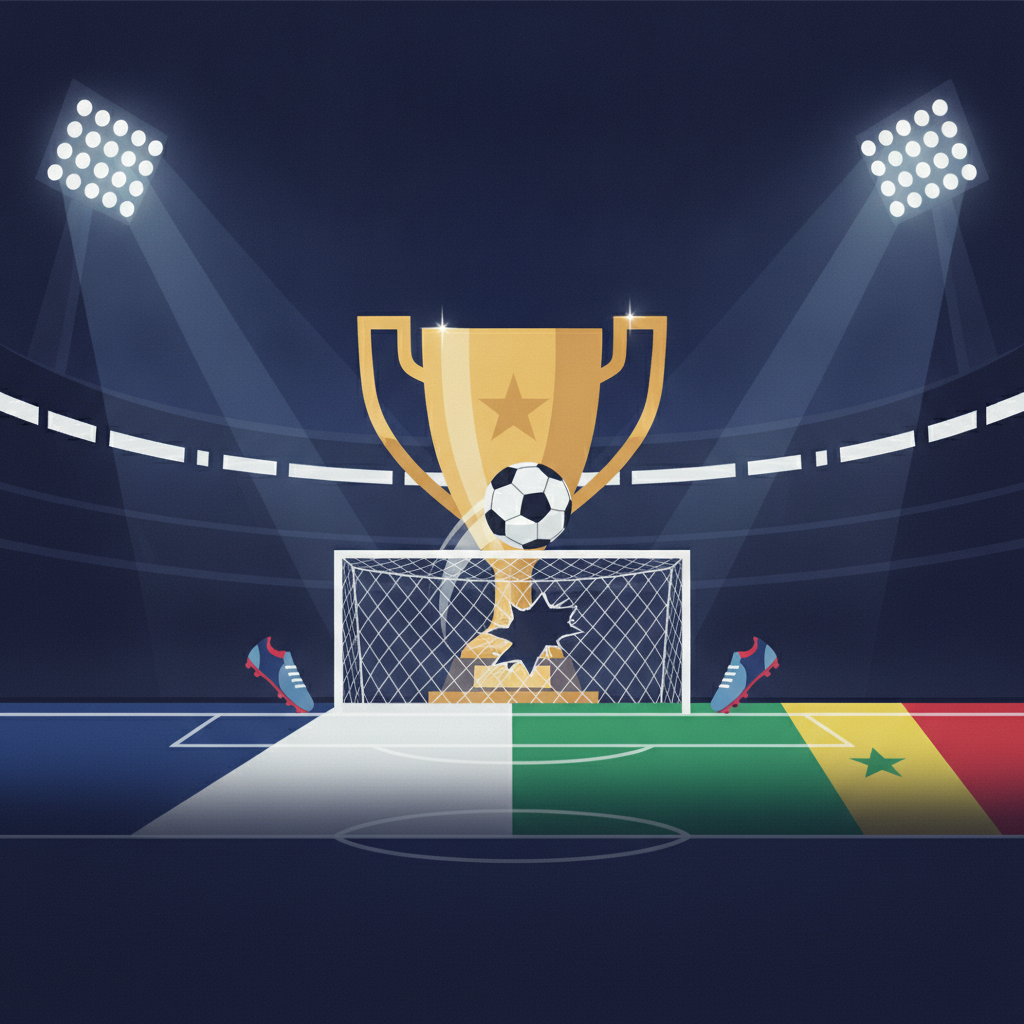
France’s victory over Senegal in their World Cup 2026 qualifier demonstrated exactly why Les Bleus enter tournaments as perennial favorites, yet the 3-1 scoreline at the Stade de France concealed a more complex narrative that speaks to the evolving landscape of international football.
The match, which unfolded before a capacity crowd predominantly draped in French tricolor, saw Didier Deschamps’ side exercise control through midfield dominance while Senegal, marshaled by manager Aliou Cissé, executed a disciplined defensive structure that frustrated the hosts for substantial periods. The Teranga Lions, runners-up at the 2022 African Cup of Nations, arrived with clear intentions of disrupting French momentum on home soil.
Kylian Mbappé, operating from his preferred left channel, opened the scoring in the 23rd minute with a characteristic burst of acceleration that left defender Abdou Diallo grasping at shadows. The Real Madrid forward, now wearing the captain’s armband following Antoine Griezmann’s international retirement, converted a precise cutback from Ousmane Dembélé after the Paris Saint-Germain teammate had carved the Senegalese defense apart with a mazy dribble through the penalty area.
The statistical dominance was immediately apparent. France completed 612 passes during the encounter, maintaining a remarkable 91% accuracy rate—a testament to the orchestrating abilities of N’Golo Kanté in the midfield pivot. The Chelsea midfielder, recalled to international duty after missing the previous qualification window through injury, provided the connective tissue between defense and attack that has defined his international career since bursting onto the scene at the 2016 European Championship.
Senegal drew level against the run of play in the 41st minute when Boulaye Dia capitalized on a defensive misunderstanding between William Saliba and Ibrahima Konaté. The AS Roma striker, who has now scored four goals in his last six international appearances, demonstrated the clinical efficiency that has made him one of Africa’s most reliable finishers. The goal momentarily silenced the home supporters and highlighted the vulnerability that exists even within France’s seemingly impenetrable defensive architecture.
The second half witnessed Deschamps introduce Eduardo Camavinga in place of Aurélien Tchouaméni, a tactical substitution that would prove decisive. The 22-year-old, increasingly viewed as the heir apparent to the legendary midfielders who have graced French football, provided additional dynamism and recovered possession an extraordinary seven times within 30 minutes of action.
Dembélé, finally delivering on the potential that has tantalized observers since his Barcelona breakthrough, doubled the French advantage in the 67th minute with a thunderous strike from outside the penalty area. The effort, which cannoned back off the underside of the crossbar before crossing the line, registered at 94 kilometers per hour—making it the hardest struck shot of any World Cup 2026 qualifier to date.
The contest was effectively settled twelve minutes from full-time when substitute Marcus Thuram nodded home from close range following皇宫 excellent delivery from Dembélé, who completed the match with two assists alongside his spectacular individual goal. The Inter Milan forward has now been involved in five goals across his last three international appearances, establishing himself as an increasingly important component of Deschamps’ attacking repertoire.
For Senegal, the result represents a setback but not a catastrophe. Cissé, who captained his nation during their memorable quarter-final run at the 2002 World Cup, will take considerable encouragement from his team’s organizational resilience and the continued development of emerging talents such as 19-year-old defensive midfielder Lamine Camara. The youngster, making his first competitive start for the national team, completed 89% of his passes and won four aerial duels against significantly more experienced opponents.
Historical context enriches this fixture beyond mere sporting significance. France and Senegal share colonial connections dating to the 17th century, when the port city of Saint-Louis served as the capital of French West Africa. Many families in contemporary France trace their heritage to this region, creating an emotional resonance that transcends conventional sporting rivalry. Approximately 180,000 Senegalese nationals currently reside in France, representing the largest diaspora community from the nation on European soil.
Looking ahead, both nations harbor realistic ambitions of World Cup glory in the expanded 2026 tournament hosted jointly by the United States, Canada, and Mexico. France, despite an underwhelming European Championship performance on home soil in 2024, possesses the individual quality to compete for silverware on any surface. Mbappé, now with 42 international goals to his name, has publicly stated his determination to lead Les Bleus to what would be their third World Cup triumph.
Senegal, meanwhile, continues building toward what Cissé describes as “the project”—a sustained period of competitiveness on the global stage that extends beyond individual tournament cycles. With the Africa Cup of Nations approaching in Morocco and qualification for the 2026 World Cup entering its critical phase, the French defeat offers valuable lessons without undermining long-term strategic objectives.
The result leaves France top of their qualification group with maximum points from three matches, while Senegal must regroup before hosting their next qualifier in Dakar. For Deschamps, whose contract extension through 2028 was confirmed earlier this week, the performance provided evidence of tactical flexibility that will prove essential as the tournament approaches. The question now becomes whether France can maintain this momentum when the qualifying campaign resumes in March, and whether Senegal can translate their evident quality into consistent results against the world’s elite nations.