
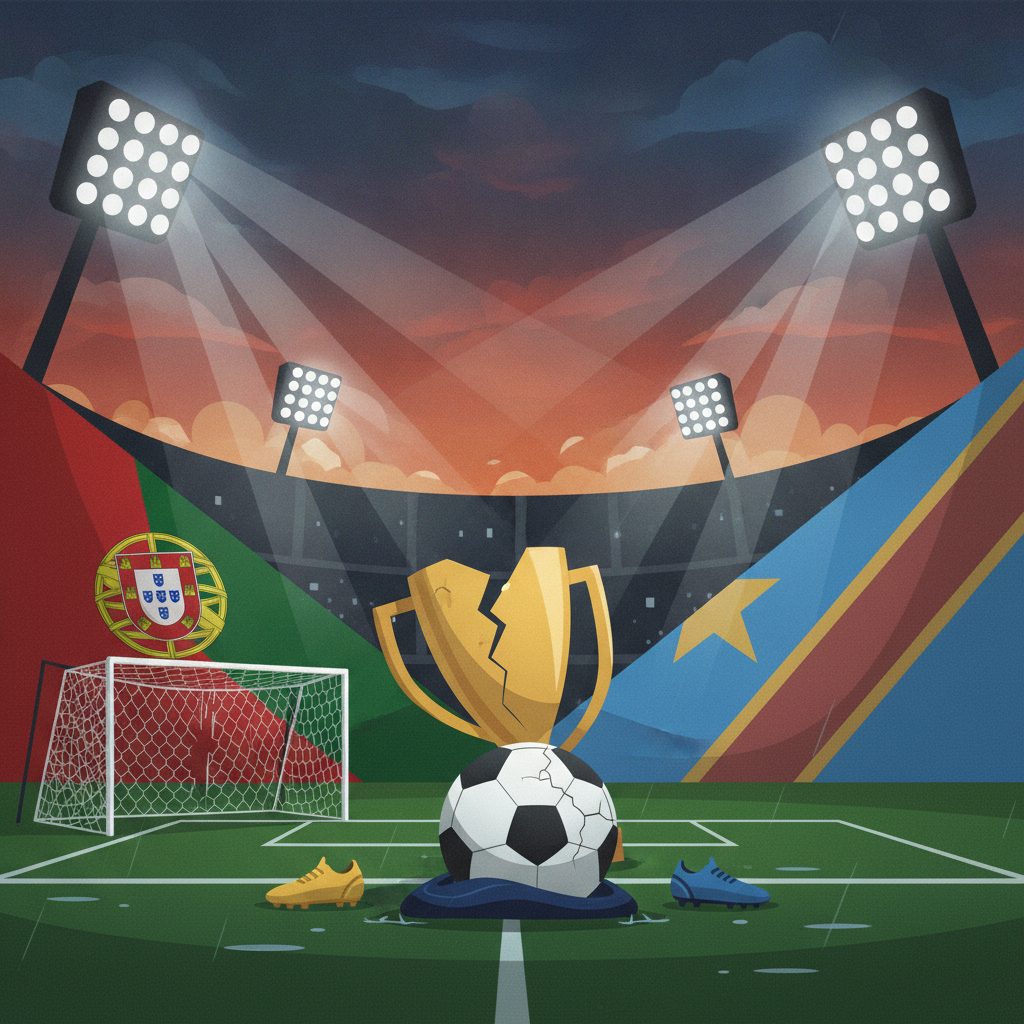
The image said everything. While the rest of the Portugal squad turned toward the stands in Houston, forming their customary formation to applaud the traveling supporters, Cristiano Ronaldo walked the opposite direction—head down, shoulders slumped, alone. In 128 international caps spanning two decades, the 39-year-old has experienced almost every conceivable emotion in a Portugal shirt. Yet Tuesday’s 1-1 draw against DR Congo in their 2026 FIFA World Cup opener represented something different: a stumble that exposed frailties a nation of 10.3 million never anticipated confronting.
The result sent shockwaves through NRG Stadium and beyond. Portugal, a team built around the talismanic figure of European football’s all-time leading scorer, had salvaged only a point against a Congolese side ranked 63rd in the world—22 places below their opponents. Bruno Fernandes’ equaliser on 72 minutes cancelled out Cedric Ohandza’s 34th-minute strike, but it felt less like a rescue and more like an escape.
The statistics reveal the uncomfortable truth for manager Roberto Martínez. Portugal managed just three shots on target across 90 minutes, their lowest tally in a World Cup match since records began. Their expected goals figure of 0.87 underscored a creative impotence that Ronaldo, despite his enduring ability to find space, could not remedy. The five-time Ballon d’Or winner touched the ball 31 times—a concerning return for a player who, even at this stage of his career, should be central to his team’s attacking architecture.
For DR Congo, this represents their most prestigious result since their 2-2 draw with Mexico at the 1974 World Cup—52 years ago. The Leopards, historically one of Africa’s powerhouse nations with their 1968 African Cup of Nations triumph, arrived in Texas having navigated qualifying with characteristic resilience. Manager Sébastien Desabre, who guided Uganda to the 2019 AFCON Round of 16, has transformed their defensive organisation, and it showed. They absorbed pressure, dealt with Portugal’s set-piece threats effectively, and struck with clinical efficiency when opportunities arose.
What makes Tuesday’s display particularly concerning for Portugal is the timing. This was supposed to be their tournament—the expanded 2026 World Cup format presenting an unprecedented opportunity for a nation that has won Euro 2016 and the 2019 Nations League but has never truly conquered the world stage. Ronaldo, appearing at his sixth World Cup, spoke before the tournament about his desire to finally win the competition that has eluded him. That dream received an unwelcome reality check.
The “Ronaldo problem” that analysts had tentatively discussed in quieter moments now demands urgent attention. His movement remains intelligent, his finishing ability undiminished, but the symbiotic relationship between player and team appears fractured. Too often on Tuesday, Portugal’s attacks broke down in the final third as teammates failed to locate Ronaldo in dangerous positions—or perhaps increasingly, chose not to. The generational transition that Portugal have delayed for years now feels unavoidable.
Roberto Martínez faces a pivotal decision. Does he persist with Ronaldo as an undisputed starter, or begin integrating the next generation more deliberately? In the short term, Portugal’s Group F situation requires immediate solutions. A meeting with a visibly confident DR Congo side will be followed by tests against stronger opposition, and the mathematical margin for error in this expanded tournament format is tighter than ever for teams targeting top spots.
Yet context matters. This was one match, against an opponent who proved more than capable on the day. Portugal have navigated slow starts before—they reached the 2006 World Cup semi-final after drawing their opening game against Angola. Ronaldo himself has responded to disappointments throughout his career with performances that defied logic and time.
The images from Houston will dominate headlines for days. Ronaldo walking alone while his teammates celebrated together tells a story of disconnect, of a legend perhaps closer to the end than anyone dared admit publicly. But the World Cup is a marathon, not a sprint. How Portugal respond in their next fixture will define whether Tuesday’s frustration becomes a footnote or a turning point in their tournament ambitions.
One thing remains certain: the eyes of a footballing world will be watching when Ronaldo next takes the field, waiting to see whether the walk of disappointment transforms into something more familiar—the stride of a player refusing to let history end this way.