
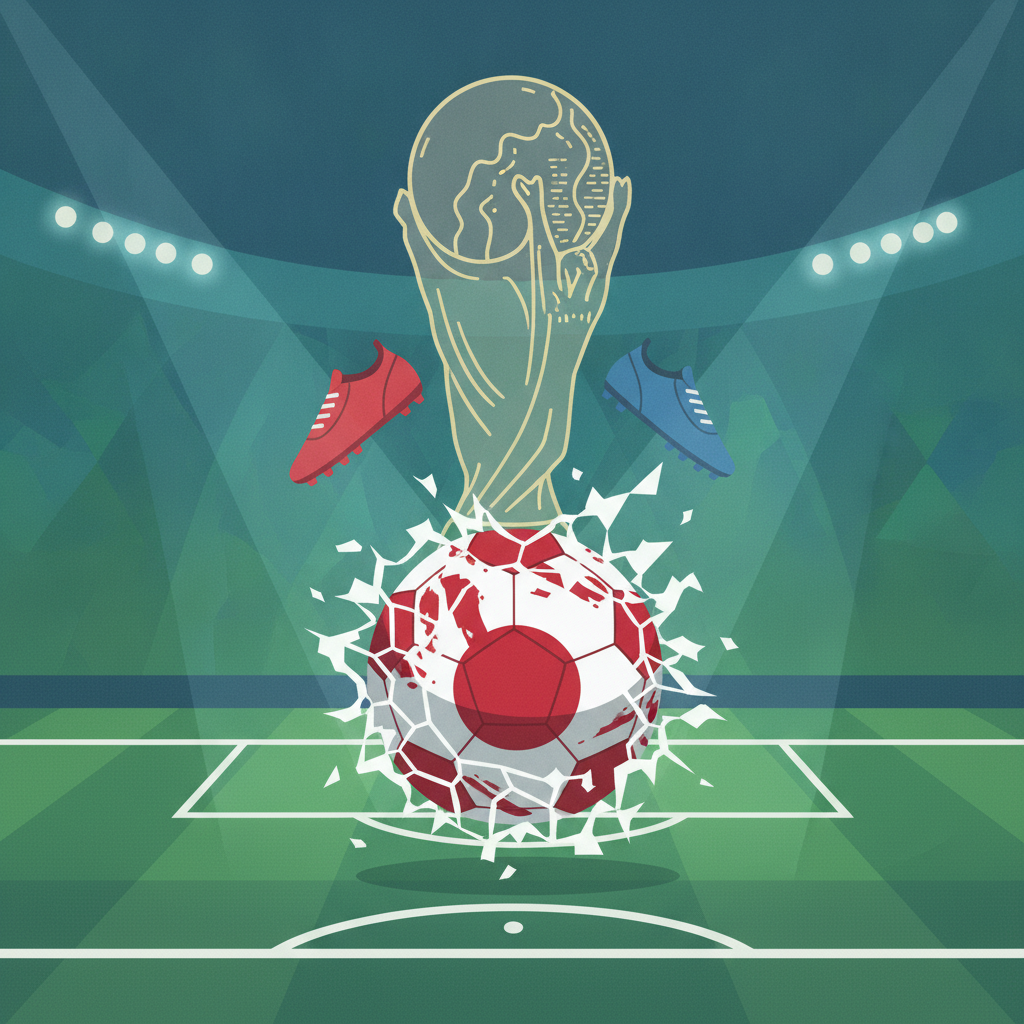
Japan enters the 2026 FIFA World Cup with a squad that blends experienced campaigners with emerging talent, yet the fundamental question remains unchanged: can the Blue Samurai finally translate group-stage promise into knockout-stage progression? As Hajime Moriyasu prepares his side for what many consider their most favorable draw in decades, the weight of history looms large over every training session and tactical briefing.
The numbers tell a stark story. In six previous World Cup appearances, Japan has never progressed beyond the round of 16. Their record includes early elimination in 1998, dramatic penalty shootout heartbreak against Turkey in 2002, group-stage exits in 2010 and 2014, a narrow last-16 defeat to Belgium in 2018 that featured that infamous counter-attack goal, and another round-of-16 departure against Croatia in Qatar four years ago. That sequence represents a quarter-century of near-misses and what-ifs, making the 2026 cycle feel almost宿命 (fated) for a generation of players who understand precisely what previous squads failed to achieve.
The expanded 48-team format, introduced for this tournament co-hosted by the United States, Canada, and Mexico, theoretically benefits Japan. With 24 of 48 teams advancing to the knockout rounds compared to 16 of 32 previously, the mathematical path has widened. Group F places Japan alongside Tunisia, with the matchup against the Carthage Eagles carrying decisive implications for advancement calculations. Tunisia, ranked 30th in the latest FIFA standings, presents a winnable opening fixture that would have seemed improbable against traditional European powers.
Historical context enriches this narrative. Tunisia’s World Cup history diverges sharply from Japan’s—while the North Africans have reached the knockout rounds twice, most recently in 2006, they have never advanced beyond that stage. The psychological dynamics between these nations favor Japan’s technical approach. Japan’s domestic league has produced increasingly sophisticated tactical systems, while Tunisia’s reliance on physicality and defensive organization could struggle against the fluid passing networks Moriyasu has implemented. The prediction markets currently favor Japan at approximately 1.85 odds, suggesting professional bookmakers recognize this tactical superiority.
Yet Tunisia represents merely the first obstacle. The wider group also contains dangers that could emerge if Japan fails to secure favorable results. Analysts examining tiebreaker scenarios have identified several pathways where Japan could survive despite dropped points, but those calculations grow increasingly complex depending on results elsewhere in the group. Every goal scored and conceded compounds in significance when head-to-head records and goal differentials determine advancement.
Moriyasu’s squad selection reveals strategic thinking. The core group includes players who featured in the 2022 campaign, providing essential tournament experience for high-pressure situations. Takefusa Kubo, now starring with Real Sociedad in La Liga, offers technical creativity in midfield positions. Brighton & Hove Albion’s Kaoru Mitoma continues demonstrating the explosive pace that terrorized defenses during qualifiers. The defensive unit, anchored by Manchester United’s Takehiro Tomiyasu, has developed the organizational discipline necessary for shutting down counter-attacking threats. These individuals represent Japan’s most technically accomplished generation, raising expectations that this cycle might finally differ from previous disappointments.
Tactical evolution matters significantly here. Japan’s approach under Moriyasu has shifted from conservative defending toward proactive possession-based football. The statistics from Asian qualifiers reinforce this transformation—Japan ranked among the tournament’s top performers in pass completion percentage and shots per match. Their pressing intensity forces opponents into errors, creating transition opportunities that the pacey forward line exploits ruthlessly. Tunisia’s coaching staff undoubtedly prepared specific defensive schemes to neutralize these patterns, but the execution gap between training ground tactics and match reality often determines outcomes.
Beyond Group F, the tournament’s broader landscape offers additional context. Germany’s presence in Group E, facing Ivory Coast in a matchup between traditional powers and emerging African football, demonstrates how the global game continues expanding beyond traditional strongholds. Colombia’s encounter with DR Congo similarly illustrates the sport’s growing geographical diversity. These contests remind observers that Japan’s ambitions exist within a broader ecosystem where traditional hierarchies constantly face disruption.
The knockout curse, as Japanese media has termed it, carries psychological dimensions that statistics cannot fully capture. Players interviewed during training camp acknowledge the pressure without dismissing it entirely. Captain Maya Yoshida, whose international career spans three World Cups, recently described the squad’s singular focus: not dwelling on past failures but channeling that accumulated disappointment into present determination. Such messaging matters when managing elite athletes who understand precisely what failure looks like.
Looking ahead, Japan’s round-of-16 prospects, should they advance, would likely involve facing runners-up from Group E or winners from another pool—potentially setting up encounters with European opposition where Japan traditionally struggles. The technical quality exists to compete, but consistency across a month-long tournament demands mental resilience that previous squads lacked in crucial moments.
The 2026 World Cup represents something unprecedented for Japanese football: genuine optimism backed by legitimate capability. The curse persists only if Japan permits it. Every pass, every defensive intervention, every tactical adjustment during matches now carries the potential to finally break through. The group stage awaits, and with it, the first opportunity to demonstrate that quarter-century of frustration has produced something meaningful.