Barcelona vs Feyenoord 5-1 - Champions League Matchday 1 Match Report
Barcelona and Feyenoord met at Spotify Camp Nou in the UEFA Champions League league phase, and the shape of the match explained the scoreline far better than the bare numbers do.
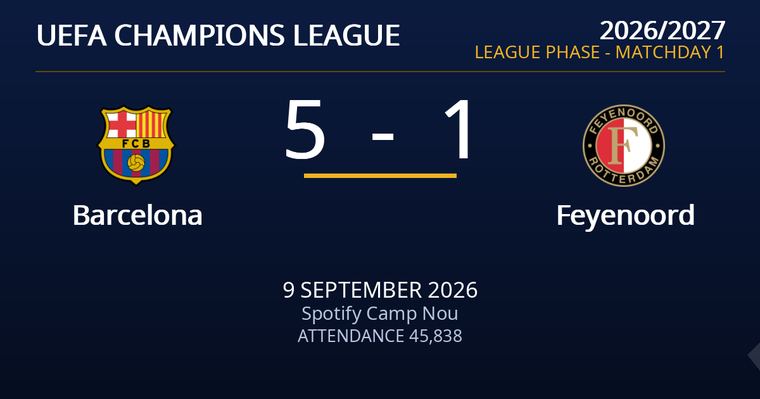
Barcelona and Feyenoord met at Spotify Camp Nou in the UEFA Champions League league phase, and the shape of the match explained the scoreline far better than the bare numbers do. Feyenoord went down to 5-1 and spent the remainder of the evening trying to pull the game back. The turning point came at the 3 minute mark, when Raphinha turned the move into the opening the team had been chasing, and everything that followed was played in that new landscape. Barcelona won 5-1 and carried the points home. 45838 supporters filled Spotify Camp Nou, and the noise never really left the players alone. Neither side arrived in the best form: the last five results read W W W W W for Barcelona and W D W D W for Feyenoord, and both sets of players knew what a slip would cost.
Match facts
- Date: 2026-09-09
- Kick-off: 16:45 UTC
- Venue: Spotify Camp Nou, Barcelona, Spain (99787)
- Attendance: 45838
- Referee: Sven Jablonski (Germany)
- Competition: UEFA Champions League 2026/2027 - Matchday 1
- Starting line-ups: Barcelona (4-3-3, Coach: Hans-Dieter Flick) / Feyenoord (4-2-3-1, Coach: Giovanni van Bronckhorst)
- Scorers: Raphinha 3'; Karim Adeyemi 22'; Raphinha 57'; Lamine Yamal 77'; Gabriel Jesus 85'; Sem Steijn 82'
Barcelona lined up with Joan García, Jules Koundé, Pau Cubarsí, Andreas Christensen, João Cancelo, Dani Olmo, Rodri, Pedri, Lamine Yamal, Raphinha, Karim Adeyemi in a 4-3-3, while Feyenoord answered with Tjark Ernst, Givairo Read, Jeremiah St. Juste, Tsuyoshi Watanabe, Mika Mármol, Gjivai Zechiël, Charles Vanhoutte, Anis Hadj Moussa, Luciano Valente, Javi López, Nacho Ferri in a 4-2-3-1. Hans-Dieter Flick and Giovanni van Bronckhorst led their respective sides from the touchline, and both had a plan for the first hour that they wanted to keep intact.
Goals and key moments
Goal details, minutes and scorers are the part of the record that separate one evening from another. At the 3' mark, Raphinha turned the move into the opening the team had been chasing, with Lamine Yamal supplying the pass that made it possible, and 1-0 was the consequence. It was a chance worth 0.485 expected goals, which is exactly why it was worth taking. 22': Karim Adeyemi struck it with quality, João Cancelo helping it over the line, and it was 2-0 almost immediately. 57': Raphinha scored cleanly, Pedri helping it over the line, and it was 3-0 almost immediately. 77': Lamine Yamal found the far corner, helping it over the line, and it was 4-0 almost immediately. 82': Sem Steijn kept the composure the moment demanded, Gonçalo Borges helping it over the line, and it was 4-1 almost immediately. 85': Gabriel Jesus turned the move into the opening the team had been chasing, Lamine Yamal helping it over the line, and it was 5-1 almost immediately. That strike changed the temperature of the evening: from that point the leading side could play for the counter while the chasing side had to take risks in the spaces that had opened up. Not every opening was taken, though, and the chances that were missed told their own story. Taken together, the goals gave the evening a shape that the scoreline on its own never explained.
The tactical picture
Barcelona started in 4-3-3 under Hans-Dieter Flick, while Feyenoord answered with 4-2-3-1 under Giovanni van Bronckhorst, and those two shapes decided most of what happened on the field. Neither manager was willing to hand the central ground over for free, and the shape of the game followed that refusal. The midfield was the part of the pitch both sides wanted, and the numbers show who managed to take it. The side that pressed high won the second ball, which left the other team unable to build from the back and forced them into hopeful passes. The width of the pitch worked against the team that kept attacking down the same flank, and they were closed down every time. Transitions were the story: one side moved the ball forward at speed, the other could not. The tactical conversation between the two benches was as much a part of the evening as the movement of the ball itself.
Tactical reading
Barcelona set up in a 4-3-3 against the 4-2-3-1 of Feyenoord, and the two shapes decided how the ball actually moved: Barcelona completed 794 passes at 94% accuracy while Feyenoord answered with 308 and 83%. The duel numbers underline the same story, as Barcelona won 54 duels against 51 for Feyenoord, completed 17 tackles to 24 and read 5 passes compared with 6. Chance creation was the decisive column of the table, with Barcelona generating 3 clear chances and 13 shots from inside the box against 2 and 3, which is exactly why the goalkeepers had to make 1 and 4 saves between them.
Statistical comparison
The statistical picture is as revealing as the scoreline itself. Expected goals told the sharper story: 2.10 for Barcelona against 0.53 for Feyenoord. Barcelona attempted 24 shots to Feyenoord's 4, with 9 on target against 2. Possession finished at 72 per cent for Barcelona against 28 per cent for Feyenoord, and it is worth noting which side actually used it. Barcelona won 4 corners to Feyenoord's 1, and that is where most of the set-piece danger came from. Barcelona completed 746 of 794 passes against 256 of 308 for Feyenoord, a difference that shows how differently the two sides circulated the ball. Fouls were committed 10 times by Barcelona and 12 by Feyenoord, with 0 and 0 red cards in the official count. The goalkeepers made 1 and 4 saves respectively, and on a night like this that work decides how the result is remembered. The duels went 54 to 51, which is usually the cleanest single indicator of who was prepared to spend effort on the ball. Tackles were completed 17 times by Barcelona and 24 by Feyenoord, and the duels that followed tell the same story as the rest of the evening.
Discipline and substitutions
Discipline and substitutions shaped the second half more than the scoreline suggests. Barcelona collected 1 yellow cards and Feyenoord 1, and the caution count of 2 in total meant the referee had to manage a game that was becoming increasingly physical around the halfway line. Both coaches used their changes: 5 by Barcelona and 5 by Feyenoord, with the last substitution of the evening coming late. The emotional temperature of the evening rose and fell with the challenges and with the decisions taken by both benches. Sven Jablonski took charge of the match and had a relatively straightforward evening by the standards of the competition.
Player of the match and the standout performers
Individual performances separated the two teams across a full ninety minutes. Lamine Yamal of Barcelona was the player of the match with a rating of 9.5, and every touch that mattered carried his name on it. For Barcelona, the best individual rating belonged to Lamine Yamal, and for Feyenoord it belonged to Sem Steijn. The gap between the best performances on each side was the reason the result never really looked as comfortable as it was. Across the two squads the highest individual ratings read Lamine Yamal (9.49), Raphinha (9.20), João Cancelo (8.69), Pedri (7.91).
What the result means for the league phase
Barcelona on points from 3 matches, in 8 place with a goal difference of 5, and Feyenoord on points from 3 matches, in 26 place with a goal difference of -4. Barcelona arrived with W W W W W in their last five and Feyenoord with W D W D W, so the result fits the run both of them have been on. For the winner the three points are banked and the group is a shade closer to settled; for the other side the work still to be done, and this result has made that plain. What the numbers cannot show is how hard the result was worked for, and how differently the two sides will remember it. The next round of the league phase will tell more: whoever adjusts first in the coming days will be the one who controls the group.
Source: worldfootballportal.com