
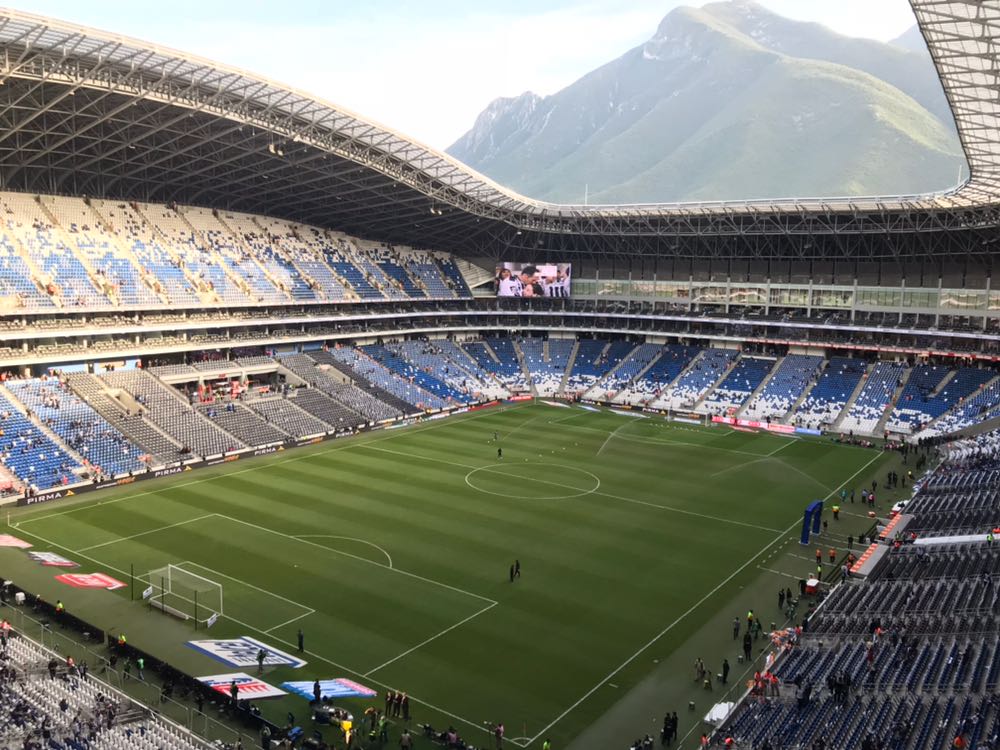

Estadio BBVA, nicknamed “El Gigante de Acero” (The Steel Giant), stands as the most technologically advanced and environmentally conscious football stadium in Mexico. Located in Guadalupe within the Greater Monterrey metropolitan area, the stadium was designed by the multinational architectural firm Populous and Mexican firm VFO, with Federico Velasco as lead designer. Construction commenced in August 2011 and the stadium opened on August 2, 2015, replacing the aged Estadio Tecnológico as home to C.F. Monterrey after 63 years.
The project commanded $200 million USD, making it the most expensive stadium ever built in Mexico at the time of construction. Its environmental credentials are remarkable: Estadio BBVA became the first football stadium in North America to achieve LEED Silver certification, recognising its sophisticated sustainable design principles. Permeable areas cover more than one-third of the total land, functioning as rainwater filtration systems that recharge local aquifers. Strategic parking integrates with a surrounding Ecological Park, while a wooded trail connects the venue to Rio La Silla.
Perhaps the most visually distinctive feature is the stadium’s orientation. From the northwestern stands, spectators see Cerro de la Silla — a striking mountain rising 1,820 metres — framing the match action, creating a visual experience that deepens fans’ connection to Monterrey’s geographic identity and regional heritage.
With a capacity of 53,529 and 34-degree grandstand inclination maximising sightlines, the facility hosts C.F. Monterrey’s Liga MX and CONCACAF Champions League matches, as well as Mexico national team fixtures. International competitions have included the 2022 CONCACAF W Championship.
For the 2026 FIFA World Cup, Estadio BBVA will host four matches — contributing to Mexico’s rich World Cup hosting legacy and presenting the world with one of football’s most scenically situated venues.