
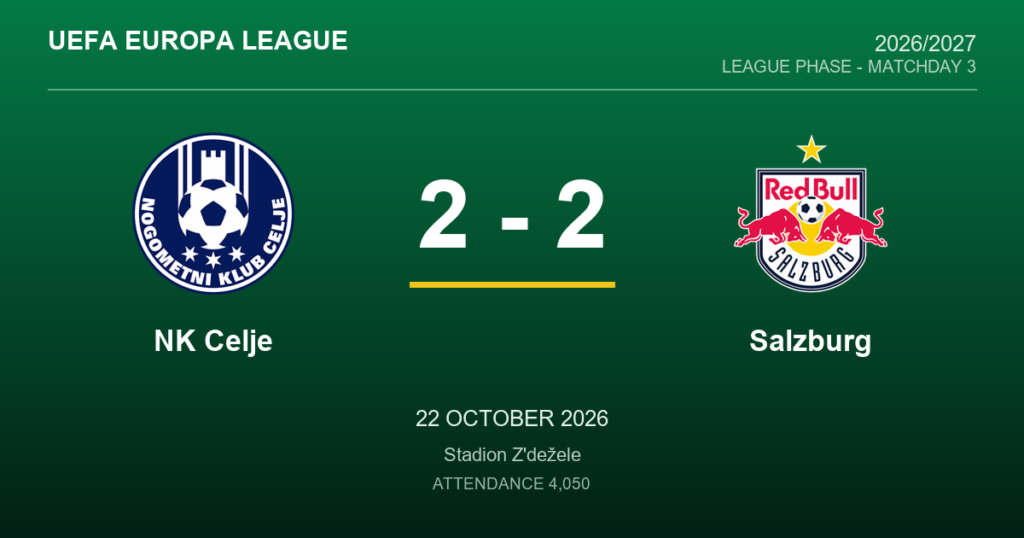
NK Celje and Salzburg met at Stadion Z’dežele in the UEFA Europa League league phase, and the shape of the match explained the scoreline far better than the bare numbers do. NK Celje and Salzburg finished level at 2-2, and neither side ever found the single moment that would have settled it. The turning point came at the 9 minute mark, when Sota Kitano scored cleanly, and everything that followed was played in that new landscape. Neither NK Celje nor Salzburg could find a way through, and the 2-2 draw left both of them looking for the same thing. 4050 supporters filled Stadion Z’dežele, and the noise never really left the players alone. Neither side arrived in the best form: the last five results read L D W L D for NK Celje and W W D L W for Salzburg, and both sets of players knew what a slip would cost.
Match facts
- Date: 22.10.2026
- Kick-off: 19:00 UTC
- Venue: Stadion Z’dežele, Celje, Slovenia (13059)
- Attendance: 4050
- Referee: John Brooks (England)
- Competition: UEFA Europa League 2026/2027 – Matchday 3
- Starting line-ups: NK Celje (4-3-3, Coach: Zoran Zeljković) / Salzburg (4-2-3-1, Coach: Danny Röhl)
- Scorers: Sota Kitano 9′ (Salzburg); Jesper Lindstrøm 46′ (Salzburg); Blaž Kramer 50′ (NK Celje); Armandas Kučys 90′ (NK Celje)
NK Celje lined up with Žan-Luk Leban, Pijus Širvys, Łukasz Bejger, Artemijus Tutyškinas, Milot Avdyli, Svit Sešlar, Mark Zabukovnik, Mario Kvesić, Veton Tusha, Blaž Kramer, Benjamin Verbič in a 4-3-3, while Salzburg answered with Christian Zawieschitzky, Leandro Morgalla, Kévin Boma, Tim Drexler, Dominik Schmid, Abubakr Barry, Umut Tohumcu, Damir Redzic, Sota Kitano, Yorbe Vertessen, Haris Tabaković in a 4-2-3-1. Zoran Zeljković and Danny Röhl led their respective sides from the touchline, and both had a plan for the first hour that they wanted to keep intact.
Goals and key moments
Goal details, minutes and scorers are the part of the record that separate one evening from another. At the 9 minute mark, Sota Kitano scored cleanly, with Damir Redzic supplying the pass that made it possible, and 0-1 was the consequence. It was a chance worth 0.21 expected goals, which is exactly why it was worth taking. That strike changed the temperature of the evening: from that point Salzburg could play for the counter while NK Celje had to take risks in the spaces that had opened up. 46′: Jesper Lindstrøm struck it with quality, Damir Redzic helping it over the line, and it was 0-2 almost immediately. The chance itself carried 0.59 expected goals of weight, and the goalkeeper had no answer to it. The opening goal of the night arrived at the 50 minute mark, when Blaž Kramer scored cleanly for 1-2. The goalkeeper would say afterwards that it was worth 0.25, and that is the harshest measure of all. Armandas Kučys struck it with quality at the 90 minute mark, Yaya Dukuly supplying the pass, and the scoreboard read 2-2. Put simply, the chance was worth 0.39 expected goals, and the finish was better than the situation deserved. Not every opening was taken, though, and the chances that were missed told their own story. Taken together, the goals gave the evening a shape that the scoreline on its own never explained.
The tactical picture
NK Celje started in 4-3-3 under Zoran Zeljković, while Salzburg answered with 4-2-3-1 under Danny Röhl, and those two shapes decided most of what happened on the field. Neither manager was willing to hand the central ground over for free, and the shape of the game followed that refusal. The midfield was the part of the pitch both sides wanted, and the numbers show who managed to take it. NK Celje’s 4-3-3 was the sharper of the two systems, and Salzburg’s 4-2-3-1 spent longer than they should have without the ball. NK Celje pressed high and won the second ball, which left Salzburg unable to build from the back and forced them into hopeful passes. The width of the pitch worked against Salzburg, who kept trying to attack down the same flank and were closed down every time. Transitions were the story: NK Celje moved the ball forward at speed, Salzburg could not. The tactical conversation between the two benches was as much a part of the evening as the movement of the ball itself.
Statistical comparison
The statistical picture is as revealing as the scoreline itself. NK Celje attempted 9 shots to Salzburg’s 15, with 3 on target against 4. The numbers that decide matches rarely tell the whole story, but they narrow the argument down to a very small area. Possession finished at 50 per cent for NK Celje against 50 per cent for Salzburg, and it is worth noting which side actually used it. Expected goals told the sharper story: 1.47 for NK Celje, 1.66 for Salzburg. NK Celje won 2 corners to Salzburg’s 3, and that is where most of the set-piece danger came from. NK Celje completed 439 of 515 passes against 437 of 512 for Salzburg, a difference that shows how differently the two sides circulated the ball. Fouls were committed 14 times by NK Celje and 10 by Salzburg, with 0 and 0 red cards in the official count. The goalkeepers made 2 and 1 saves respectively, and on a night like this that work decides how the result is remembered. The duels went 47 to 43, which is usually the cleanest single indicator of who was prepared to spend effort on the ball. Tackles were completed 21 times by NK Celje and 17 by Salzburg, and the duels that followed tell the same story as the rest of the evening. NK Celje managed 8 shots from inside the penalty area compared with 10 for Salzburg, which is the clearest single indicator of where the game was actually played.
Discipline and substitutions
Discipline and substitutions shaped the second half more than the scoreline suggests. NK Celje collected 2 yellow cards and Salzburg 2, with Artemijus Tutyškinas (32′), Damir Redzic (35′), Pijus Širvys (43′) among the bookings. The caution count of 4 in total meant the referee had to manage a game that was becoming increasingly physical around the halfway line. Both coaches used their changes: 4 by NK Celje and 4 by Salzburg, with the last substitution of the evening coming at the 90+4 minute mark. The emotional temperature of the evening rose and fell with the challenges and with the decisions taken by both benches. John Brooks took charge of the match and kept a close eye on a game that grew untidy in the middle third.
Player of the match and the standout performers
Individual performances separated the two teams across a full ninety minutes. Damir Redzic of Salzburg was the player of the match with a rating of 8.7, and every touch that mattered carried his name on it. For NK Celje, the best individual rating belonged to Blaž Kramer (7.82). For Salzburg, the best individual rating belonged to Damir Redzic (8.68). The gap between the best performances on each side was the reason the result never really looked as comfortable as it was. The goalkeeping was worth a mention too: Žan-Luk Leban made 2 saves for NK Celje, and Christian Zawieschitzky made 1 for Salzburg. Across the two squads the highest individual ratings read Blaž Kramer (7.82), Svit Sešlar (7.72), Damir Redzic (8.68), Abubakr Barry (7.76).
What the result means for the league phase
NK Celje on 1 points from 3 matches, in 29th place with a goal difference of -5 and Salzburg on 4 points from 3 matches, in 21st place with a goal difference of -3. NK Celje arrived with L D W L D in their last five and Salzburg with W W D L W, so the result fits the run both of them have been on. Neither camp will be satisfied with a point, and for both of them the next round carries a little more weight than it would have done yesterday. What the numbers cannot show is how hard the result was worked for, and how differently the two sides will remember it. The next round of the league phase will tell more: whoever adjusts first in the coming days will be the one who controls the group.