
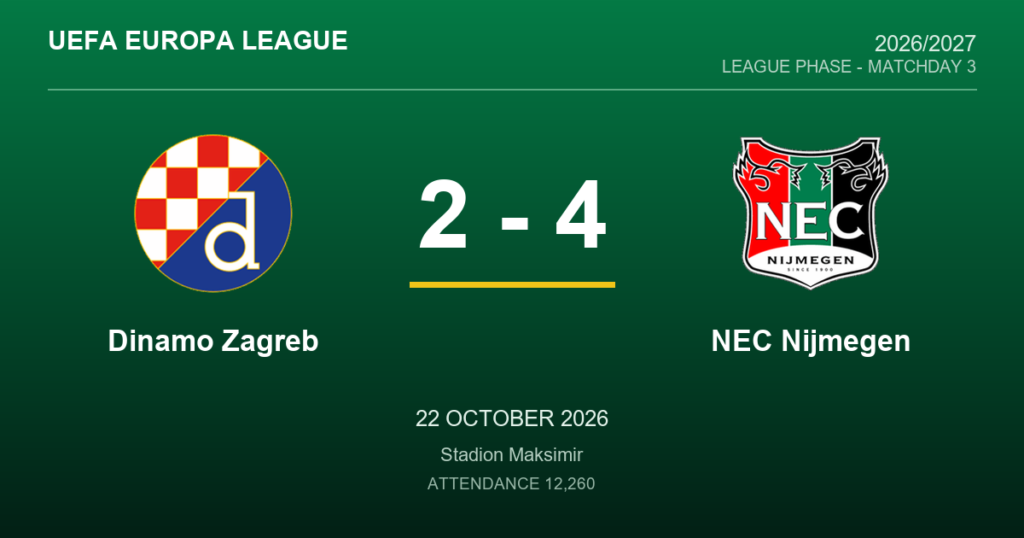
Dinamo Zagreb and NEC Nijmegen met at Stadion Maksimir in the UEFA Europa League league phase, and the shape of the match explained the scoreline far better than the bare numbers do. NEC Nijmegen turned the tie around and left Dinamo Zagreb to chase the game for the best part of the second half. The turning point came at the 25 minute mark, when Clement Bischoff scored cleanly, and everything that followed was played in that new landscape. NEC Nijmegen won 4-2 and carried the points home. 12260 supporters filled Stadion Maksimir, and the noise never really left the players alone. Neither side arrived in the best form: the last five results read W W L W W for Dinamo Zagreb and L D D D D for NEC Nijmegen, and both sets of players knew what a slip would cost.
Match facts
- Date: 22.10.2026
- Kick-off: 16:45 UTC
- Venue: Stadion Maksimir, Zagreb, Croatia (37168)
- Attendance: 12260
- Referee: Manfredas Lukjančukas (Lithuania)
- Competition: UEFA Europa League 2026/2027 – Matchday 3
- Starting line-ups: Dinamo Zagreb (4-1-4-1, Coach: Mario Kovačević) / NEC Nijmegen (3-4-2-1, Coach: Dick Schreuder)
- Scorers: Clement Bischoff 25′ (NEC Nijmegen); Dion Drena Beljo 33′ (Dinamo Zagreb); Dion Drena Beljo 37′ (Dinamo Zagreb); Bryan Linssen 45′ (NEC Nijmegen); Bryan Linssen 54′ (NEC Nijmegen); Tjaronn Chery 80′ (NEC Nijmegen)
Dinamo Zagreb lined up with Dominik Kotarski, Niko Galešić, Sergi Domínguez, Scott McKenna, Matteo Perez Vinlöf, Josip Mišić, Iker Almena, Luka Stojković, Luka Ivanušec, Arbër Hoxha, Dion Drena Beljo in a 4-1-4-1, while NEC Nijmegen answered with Gonzalo Crettaz, Tobias Storm, Ahmetcan Kaplan, Deveron Fonville, Perr Schuurs, Darko Nejašmić, Dennis Geiger, Clement Bischoff, Tjaronn Chery, Noé Lebreton, Bryan Linssen in a 3-4-2-1. Mario Kovačević and Dick Schreuder led their respective sides from the touchline, and both had a plan for the first hour that they wanted to keep intact.
Goals and key moments
Goal details, minutes and scorers are the part of the record that separate one evening from another. At the 25 minute mark, Clement Bischoff scored cleanly, with Tobias Storm supplying the pass that made it possible, and 0-1 was the consequence. It was a chance worth 0.23 expected goals, which is exactly why it was worth taking. That strike changed the temperature of the evening: from that point NEC Nijmegen could play for the counter while Dinamo Zagreb had to take risks in the spaces that had opened up. 33′: Dion Drena Beljo scored cleanly, Matteo Perez Vinlöf helping it over the line, and it was 1-1 almost immediately. The chance itself carried 0.12 expected goals of weight, and the goalkeeper had no answer to it. The opening goal of the night arrived at the 37 minute mark, when Dion Drena Beljo struck it with quality for 2-1. The goalkeeper would say afterwards that it was worth 0.99, and that is the harshest measure of all. Bryan Linssen scored cleanly at the 45 minute mark, Clement Bischoff supplying the pass, and the scoreboard read 2-2. Put simply, the chance was worth 0.13 expected goals, and the finish was better than the situation deserved. 54′: Bryan Linssen scored cleanly, and the arena had barely settled before it was 2-3. It did not need much to fall at 0.13 expected goals, but the execution in the finishing was immaculate. The opening goal of the night arrived at the 80 minute mark, when Tjaronn Chery scored cleanly for 2-4. It was a chance worth 0.08 expected goals, which is exactly why it was worth taking. Not every opening was taken, though, and the chances that were missed told their own story. Taken together, the goals gave the evening a shape that the scoreline on its own never explained.
The tactical picture
Dinamo Zagreb started in 4-1-4-1 under Mario Kovačević, while NEC Nijmegen answered with 3-4-2-1 under Dick Schreuder, and those two shapes decided most of what happened on the field. The midfield was the part of the pitch both sides wanted, and the numbers show who managed to take it. Neither manager was willing to hand the central ground over for free, and the shape of the game followed that refusal. NEC Nijmegen’s 3-4-2-1 was the sharper of the two systems, and Dinamo Zagreb’s 4-1-4-1 spent longer than they should have without the ball. NEC Nijmegen pressed high and won the second ball, which left Dinamo Zagreb unable to build from the back and forced them into hopeful passes. The width of the pitch worked against Dinamo Zagreb, who kept trying to attack down the same flank and were closed down every time. Transitions were the story: NEC Nijmegen moved the ball forward at speed, Dinamo Zagreb could not. The tactical conversation between the two benches was as much a part of the evening as the movement of the ball itself.
Statistical comparison
The statistical picture is as revealing as the scoreline itself. Expected goals told the sharper story: 2.63 for Dinamo Zagreb, 1.39 for NEC Nijmegen. Possession finished at 58 per cent for Dinamo Zagreb against 42 per cent for NEC Nijmegen, and it is worth noting which side actually used it. Dinamo Zagreb attempted 16 shots to NEC Nijmegen’s 15, with 10 on target against 5. The numbers that decide matches rarely tell the whole story, but they narrow the argument down to a very small area. Dinamo Zagreb won 5 corners to NEC Nijmegen’s 2, and that is where most of the set-piece danger came from. Dinamo Zagreb completed 436 of 516 passes against 285 of 361 for NEC Nijmegen, a difference that shows how differently the two sides circulated the ball. Fouls were committed 11 times by Dinamo Zagreb and 18 by NEC Nijmegen, with 0 and 0 red cards in the official count. The goalkeepers made 1 and 7 saves respectively, and on a night like this that work decides how the result is remembered. The duels went 47 to 56, which is usually the cleanest single indicator of who was prepared to spend effort on the ball. Tackles were completed 15 times by Dinamo Zagreb and 25 by NEC Nijmegen, and the duels that followed tell the same story as the rest of the evening. Dinamo Zagreb managed 11 shots from inside the penalty area compared with 11 for NEC Nijmegen, which is the clearest single indicator of where the game was actually played.
Discipline and substitutions
Discipline and substitutions shaped the second half more than the scoreline suggests. Dinamo Zagreb collected 1 yellow cards and NEC Nijmegen 2, with Dion Drena Beljo (24′), Noé Lebreton (44′), Clement Bischoff (90+3′) among the bookings. The caution count of 3 in total meant the referee had to manage a game that was becoming increasingly physical around the halfway line. Both coaches used their changes: 5 by Dinamo Zagreb and 5 by NEC Nijmegen, with the last substitution of the evening coming at the 90 minute mark. The emotional temperature of the evening rose and fell with the challenges and with the decisions taken by both benches. Manfredas Lukjančukas took charge of the match and had a relatively straightforward evening by the standards of the competition.
Player of the match and the standout performers
Individual performances separated the two teams across a full ninety minutes. Tjaronn Chery of NEC Nijmegen was the player of the match with a rating of 9.1, and every touch that mattered carried his name on it. For Dinamo Zagreb, the best individual rating belonged to Dion Drena Beljo (8.84). For NEC Nijmegen, the best individual rating belonged to Tjaronn Chery (9.07). The gap between the best performances on each side was the reason the result never really looked as comfortable as it was. The goalkeeping was worth a mention too: Dominik Kotarski made 1 saves for Dinamo Zagreb, and Gonzalo Crettaz made 7 for NEC Nijmegen. Across the two squads the highest individual ratings read Dion Drena Beljo (8.84), Josip Mišić (7.03), Tjaronn Chery (9.07), Clement Bischoff (8.87).
What the result means for the league phase
Dinamo Zagreb on 4 points from 3 matches, in 18th place with a goal difference of -1 and NEC Nijmegen on 4 points from 3 matches, in 20th place with a goal difference of -3. Dinamo Zagreb arrived with W W L W W in their last five and NEC Nijmegen with L D D D D, so the result fits the run both of them have been on.